The Brothers in Granite: A New Compass for the Arena
History records that when the weight of the presidency threatened to crush him, Theodore Roosevelt would retreat to the quiet of his office, lock his eyes onto a portrait of Abraham Lincoln, and ask a solitary, stabilizing question: "What would Lincoln do?"
Lincoln was TR’s moral anchor. When he faced agonizing depths of national crises, or balanced the fragile scales of a rapidly modernizing nation, Roosevelt did not look to his critics or the shifting winds of public opinion. He looked to the quiet, intense gaze of the man who preserved the Union. He borrowed Lincoln’s courage to fuel his own.
But history does not stand still. It builds. It layers granite upon granite.
Today, when we look at the colossal stone faces carved into Mount Rushmore, we see those two monumental spirits side by side. Lincoln, the preserver of the nation's soul, and Roosevelt, the builder of its modern strength. They are brothers in granite.
And it is time we expand our compass.
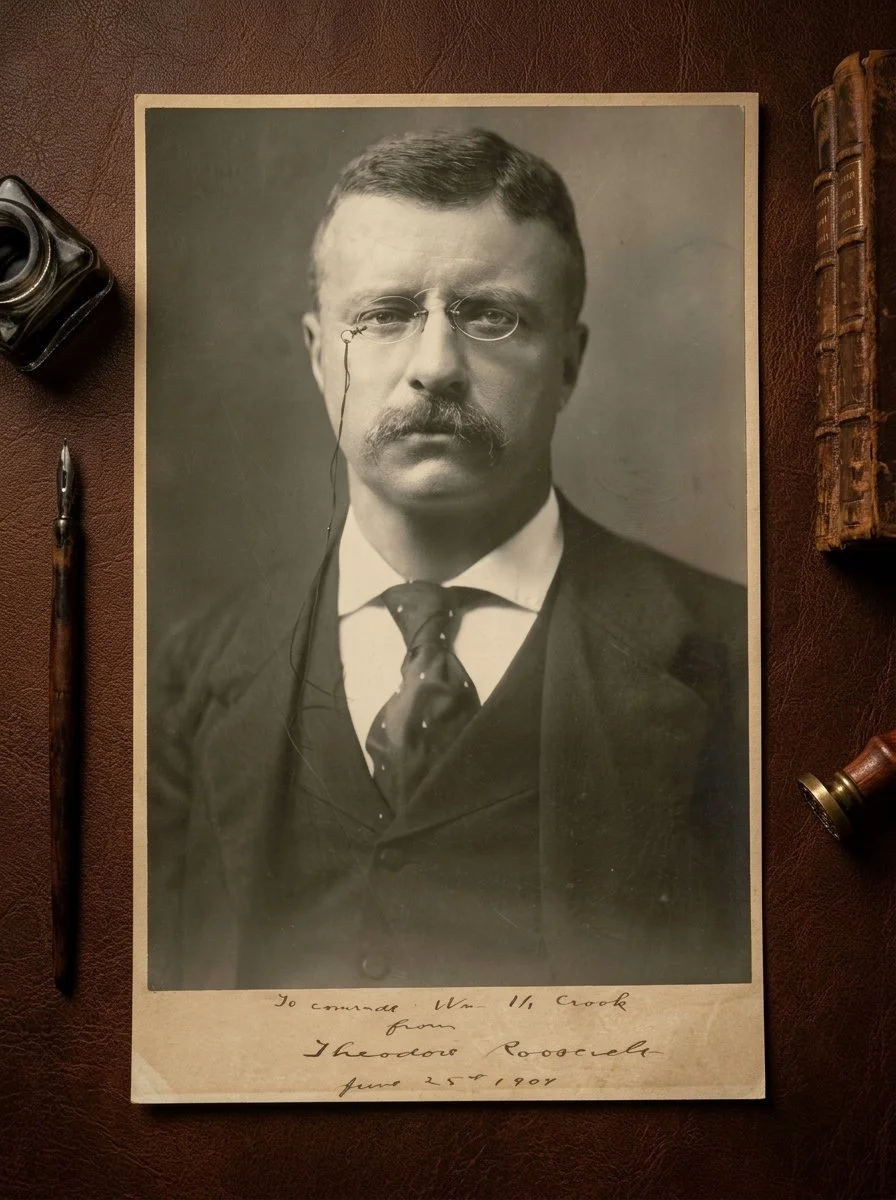
The photograph accompanying this post carries a remarkable weight. It is the exact, definitive image that Theodore Roosevelt chose to gift to Colonel William H. Crook—a man who served as a White House staff member and bodyguard from Lincoln’s administration all the way through TR’s own presidency. Crook saw the heavy majesty of Lincoln firsthand, and he saw the explosive, joyful, strenuous life of Roosevelt. TR knew exactly what this image represented when he handed it to a man who had walked with giants.
This dialogue between the two presidents took a physical, permanent form in the autumn of 1903. It was on October 5, 1903, that Roosevelt wrote a letter to the American realist painter Ernest G. Wells, thanking him for the gift of a stunning oil portrait of a clean-shaven, pre-war Lincoln. Roosevelt was so deeply moved by the depiction that he hung it directly in his newly built West Wing office, making it the central visual touchstone opposite his desk for the remainder of his presidency. From that moment on, whenever the room grew quiet and the decisions grew heavy, TR looked up at Wells’s canvas to find his bearings.
If Roosevelt could look at Wells's painting of Lincoln to find his direction, then we can look to Roosevelt. As I establish the artistic vision for Lincoln Painting, this is the thought-concept loop I want to bring to life. I want to look past the centuries, fix my gaze on his brother in granite, and ask with that same desperate clarity:
"What would TR do?"
What would the Roosevelt do when faced with a crisis of courage? What would he do when complacency feels easier than action? He would choose the strenuous life. He would demand a square deal. He would disregard the cynics, dust the dirt off his uniform, and keep fighting.
Let this photograph be more than a relic of the past on my site today. Let it be a living mirror. The next time you face a choice that requires absolute conviction, don't look down at your doubts. Look up at the Colonel's photograph. Step into the arena. Ask yourself what TR would do—and then go do it.