The First Custodian: How Artists Create the Invisible Architecture of Value
When we speak about the value of a painting, we tend to speak in the language of surface. We discuss composition, condition, brushwork, palette, period, attribution. These are essential matters. They form the bedrock of connoisseurship and protect the integrity of the object.
But long before a museum acquires a painting, before a critic interprets it, before an auction house assigns it an estimate, the work has already acquired something far more decisive than varnish or provenance. It has acquired its invisible architecture.
That architecture is constructed by the artist.
The artist is the first custodian not only of the physical object, but of its non-physical life — its meaning, its legitimacy, its cultural positioning, its narrative gravity. And the way an artist inaugurates that life often determines whether a work will endure as decoration or survive as history.
Art Does Not Begin as a Commodity
When a painting leaves the studio, it enters a world of institutions, collectors, curators, and markets. But at the moment of its creation, it is not yet a commodity. It is an event. It is an act of intention crystallized in material form.
The artist determines the terms of that event.
Is the work an aesthetic exercise? A meditation on mortality? A confrontation with political injustice? A reclamation of cultural memory? A dialogue with a specific tradition? A rupture from one?
These decisions are not abstract. They shape how the work will be read, framed, and valued for decades to come.
Consider the difference between two hypothetical paintings of similar technical excellence.
One is a beautifully rendered landscape titled Untitled #12.
The other, equally skillful, is titled After the River Was Divided, referencing a specific historical displacement. The artist publishes a brief statement explaining that the river in the painting marks the forced relocation of a community, and that the work is part of an ongoing inquiry into inherited geography and memory.
The paint may be equally refined. But the second work carries narrative density. It enters the world with coordinates. It has declared its terrain.
The artist has added substance that cannot be measured in pigment.
Intention as Infrastructure
There is a persistent myth that great art “speaks for itself.” In truth, art speaks within a language. And artists either help construct that language around their work or leave it vulnerable to others’ assumptions.
Intention is not about telling viewers what to think. It is about clarifying the field in which the work operates.
When artists articulate their philosophical, political, or cultural commitments, they are building interpretive infrastructure. They are ensuring that future historians, curators, and collectors understand the stakes of the work.
Think of artists who issued manifestos. The Impressionists did not merely paint differently; they positioned themselves against the academic establishment. The Surrealists did not simply produce strange imagery; they articulated a theory of the unconscious. The Mexican muralists embedded their work explicitly in revolutionary politics and public education.
Their paintings carry weight because their creators embedded them in discourse.
Without such framing, art risks becoming visually compelling but historically unmoored.
The Artist as Architect of Provenance
We often treat provenance as something that accumulates after the work leaves the studio. Yet the earliest and most formative layer of provenance begins with the artist’s own custodianship.
How carefully does the artist document the work? Is the date recorded? Are materials specified? Is there archival photography of the piece in the studio? Is correspondence preserved that discusses its conception? Are early exhibitions documented?
These actions may seem administrative, but they are acts of stewardship. They signal seriousness. They provide future scholars and institutions with a traceable intellectual life.
Even the choice of first collector matters. When an artist places work intentionally — perhaps with a patron aligned with the work’s values or within a collection known for intellectual rigor — the narrative begins with coherence rather than randomness.
The Invisible Layer of Persona
The biography of the artist inevitably intertwines with the artwork. This is not a matter of celebrity; it is a matter of alignment.
When an artist’s lived commitments reinforce the themes of their work, the non-physical properties deepen. An artist painting about exile who has experienced displacement. An artist confronting industrial collapse who grew up in a factory town. An artist interrogating colonial memory who has conducted research within affected communities.
This does not mean biography determines meaning. But coherence between life and inquiry creates legitimacy. It becomes part of the work’s aura — its presence as something anchored in lived reality rather than aesthetic opportunism.
Markets respond to this, even when they pretend not to. Institutions respond to it. Audiences sense it intuitively.
Community as Context
No artwork is born in isolation. It emerges from conversations — with teachers, movements, intellectual traditions, cultural histories.
When artists consciously situate their work within these networks, they thicken its meaning. To work within a lineage is to acknowledge ancestry. To break from a lineage is to declare intention. Both gestures generate interpretive force.
Consider how the Harlem Renaissance created a framework through which individual works were understood not simply as paintings or poems, but as contributions to a larger cultural awakening. Or how postwar abstraction in New York became entangled with philosophical and geopolitical tensions of its time.
The individual canvas mattered. But its embeddedness mattered more.
Artists who recognize themselves as participants in larger dialogues amplify the future resonance of their work.
The Power of Coherence
Non-physical value accumulates through continuity of inquiry.
An artist who moves opportunistically from trend to trend may produce visually striking objects, but the narrative becomes thin. There is no sustained question, no deepening investigation, no philosophical arc.
In contrast, when an artist pursues a question across years — refining it, complicating it, revisiting it — the body of work becomes intellectually legible. Scholars can trace evolution. Curators can construct exhibitions that reveal development. Collectors can understand the stakes.
Coherence creates gravity.
Gravity attracts serious attention.
Silence and Strategy
Not all artists articulate their intentions overtly. Some choose silence. But even silence can be strategic. A refusal to explain can create tension, mystery, or openness that becomes part of the work’s identity.
The difference lies in whether the silence is deliberate or accidental.
Deliberate ambiguity can be powerful. Accidental ambiguity can lead to misinterpretation, dilution, or co-option.
The artist, as first custodian, determines which path the work takes.
Why This Matters
We live in a moment when art circulates globally, when markets move quickly, and when cultural debates are intense. In such a landscape, paintings that lack narrative density risk being absorbed as décor. Paintings that carry articulated meaning, ethical awareness, and cultural positioning endure.
The artist cannot control how history will ultimately judge their work. But they can control the conditions under which it enters the world.
They can plant it in shallow soil — trend-driven, aesthetically pleasing, quickly marketable.
Or they can plant it in deep soil — historically aware, culturally embedded, intellectually rigorous.
The roots will determine how long it stands.
The Weight Beyond the Canvas
A painting is never only what we see.
It is the residue of decisions, commitments, contexts, and conversations. It is the material trace of an artist’s encounter with their time.
The artist is the first to give that encounter form. The first to frame its meaning. The first to protect or neglect its narrative integrity.
Museums may canonize it. Critics may reinterpret it. Markets may inflate or deflate its price.
But the invisible architecture — the non-physical life of the work — begins at the moment the artist decides what, and why, and for whom the work exists.
In that sense, the artist is not simply a maker of objects.
They are the founding steward of meaning.
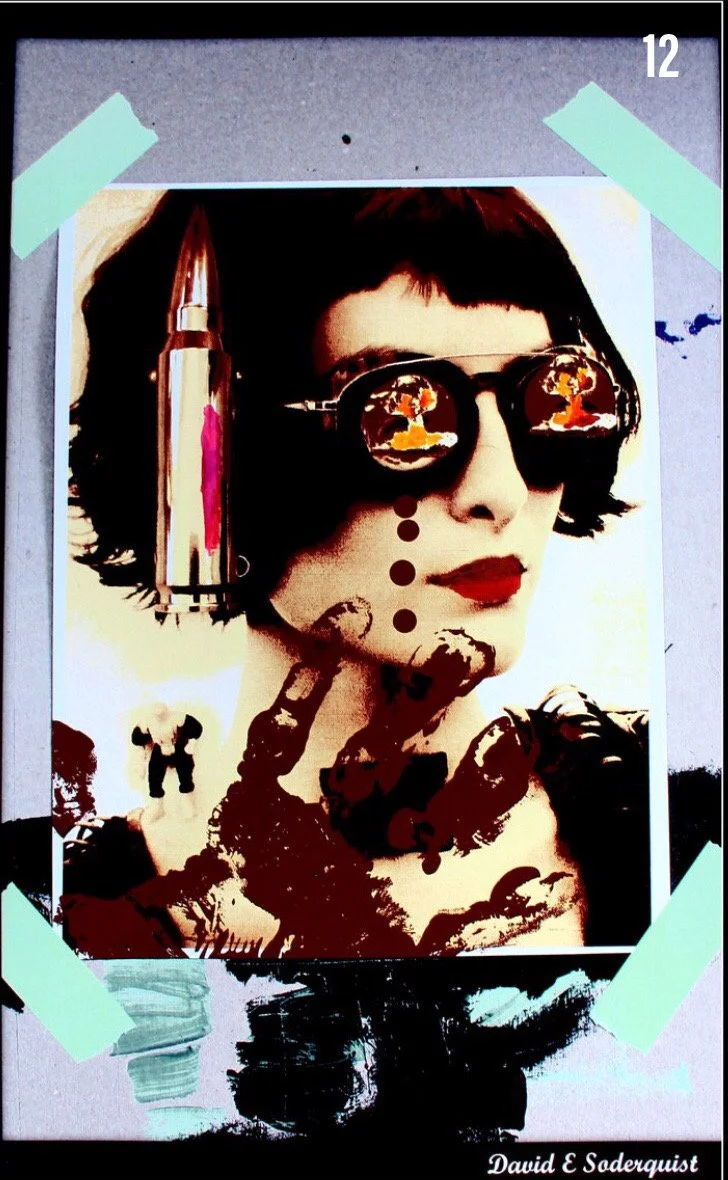
Tears of Blood, in any nuclear exchange we will all have blood on our hands, the green tape symbolizes the fleeting aspect of our lives, the little toy symbolizes our childhood and above it is adulthood that embraces bullets. The number 12 was the entry number for a number of pieces I submitted to an art show at the Everson. Now it stands for 12 disciples. May God bless us and keep us.